College life hacks from Nerdify

 0
0
 0
0
Academic life is full of challenges. As soon as students get into college they are constantly being bombarded with new information. Quite often folks have to relocate to another city and hence meet lots of new people in a very short timespan. Those are certainly both stressful and exciting times. Our team at Nerdify thought it’s going to be a good idea to share some life hacks with you so that you could make the most out of your time in college.
1. Get to know your college and lecturers.
College is not just a place where you get your degree, it’s more than that. The first thing you should do is get to know the place where you are studying – student unions, special offers you get with your student card, career fairs conducted by the local business and so on. Usually, there are plenty of opportunities lying around, so it’s a good thing to at least know where they are.
Next thing – get to know your teachers. Everyone is different, everyone requires a unique approach and almost everyone is biased (we are human beings after all). So the more you know about your lecturers the more you know how to approach them (during exams, mid-terms, revision time etc). This kind of information is always useful.
2. Create a group-chat with your class
Create a group of your class on either social media site or on some type of messenger app. Post important class updates, copies of lecture notes, schedule updates.
It’s best to have several chats depending on a topic. For example, “important announcements”, “lecture notes” and “homework chat”. That way you won’t flood one chat will lot’s of messages on various topics. Have chat guidelines, so that everyone is on the same level on what they can or cannot post
3. Take written notes during lectures
Taking notes during the lecture is one of the best things you can do if you want to absorb and understand the material. But, it turns out how you take your notes is also important. There have been studies that showed that writing things down on a paper actually makes you remember more than if you would by typing on a laptop for example. If you are dead serious about not using paper though, use stylus apps as an alternative.
4. Revise your notes on regular basis
This is the easiest lifehack out there. (Nerdify’s favorite) Read your lecture notes once a month or so. Our memory works in such a way that if we do not use the information we learn it fades away in time. Not only reading notes will make you remember the academic material better, you will also notice “blind spots” in your knowledge much earlier than you otherwise would (not 2 weeks before the final example, for example 🙂
5. Networking!
College is a perfect time to network like crazy. Many people start their first businesses in college due to extensive networking and later in your professional career – the alumni network you have will be the go-to place if you need to reach out to contacts outside your local network of colleagues and friends.
Here at Nerdify, we think that being in college is one of the most fun time you’ll have in your life. Absorb all the knowledge you can (not necessarily lectures), do sports, travel, party, get to know as many people as possible. But, if you ever get buried with work and need a helping hand – get in touch, we’ll get you sorted 🙂
-

Hey there, pal! Without a doubt, you have many questions about college life! It reminds you of an ocean full of unknown and probably dangerous species. But no worries, cuz Nerdify is here to help!
Making it through your freshman year at college is like stepping on a way of the warrior – the secret is to learn how to fight for your rights as you learn, analyze, interact, become organized, and start to think strategically. No, the real trick is to have fun no matter what! Here are some helpful tips to guide you through the first year of college life without too much trouble, stress, and anxiety.
Getting Organized Is the Key!

You have read it right – you have to become organized no matter what as it is one of the most important skills that you should have in order to survive through college. It does not matter what your strong and weak sides are because you have to work on other issues. They are time management, learning all the due dates for important diverse events, keeping track of available funds, and so on. We have it summed up for you, so you know what parts of your life have to be under control:
1. Use organizers, smartphone applications or a big calendar on your wall to keep track of all the critical deadlines. It should not only be about college but about anything that is important in your life. Even birthdays, invitations, financial matters, family gatherings, and scheduled meetings with college professors.
2. Organize each task from the urgent to less urgent and less difficult to most difficult assignments. This allows you to manage your time and physical strength by starting with the most important tasks first while knowing what tasks can be easily completed to help you feel satisfied.
3. Create a budget for yourself, consult with your friends and family, so you can get a word of advice and see how you can feel financially secure.
Become a Jedi of Social Interaction.
You have to work really hard on your personality and place in the society as you enter college. It is not really difficult to become a Jedi of social interaction! No matter how complicated your studies may be, your strong social skills, charisma, warm smile or a friendly pat on the back will always do much more than you can imagine! So, what exactly has to be done? Okay, just follow this list:
1. Do not miss meetings with your professors. There are special scheduled hours that all professors have, so take advantage of each opportunity and speak of what makes you feel concerned.
2. Meet your academic adviser. This person is really important for your success and college progress, so getting to know him or her and becoming friends is critical. In case something does not work, remember that you can always ask for another academic adviser.
3. As a part of social interaction, get involved in all things campus: student organizations, clubs, voluntary work, all kinds of fraternities, if you would like. Start a band or become a part of a college sports team. You will not only make new friends and learn some amazing skills but will eventually feel connected and at home.
4. Build a network of friends, meet new people, and do not be afraid of taking mentoring roles to support and help other people.
Building a Bridge Between Studies and Times of Leisure.
One of the worst challenges a college warrior faces is fighting for the girl or a guy he or she has a crush on. No, seriously, it is quite an issue! Just be yourself and speak of your feelings! Unfortunately, romance is not the only problem you will face at college.
Okay, now another challenge is finding a right balance between the studies and times of leisure. Out of all things, find a cozy and calm place where you can study and concentrate. Next, study course syllabus more than twice and see when and what are your due dates, so you can plan that party without damaging your academic progress. College life is always balancing between your social life and study-related events, so the best thing you can do is make it 50/50. You have to study hard, so you can party hard!
As you strive for good grades, do not forget to use all the available study resources on campus. If there are learning labs and tutors, make sure that you use their help even if you think that you do not need it. After all, they have a purpose to be here… and that purpose is YOU! Still, if you do not think that it is an option, try to become a part of study groups, so you and your friends can schedule the same time for studies and leisure. This way you can find some peace and stop feeling like letting someone down!
Battle of Priorities

We are sure that you have heard it all before, but we will say it again that college life, especially the freshman year, is a battle of priorities where important things should come first. Okay, but what is important and how to understand what is really important? Yes, studying is necessary, but unlike most guides, we want to tell you that taking some time for yourself is just as important as academia! If you feel totally stressed, no high grades will be of any good. Even if it is your favorite television show, writing a journal, playing guitar or just riding a bicycle through the park, it is just as important!
All you have to do is to take full responsibility for what you choose and work on your priorities. Try to take one step at a time as you study and make a list of what tasks are closer to the deadline, what college assignments should be done as soon as possible to stop making your life a mess. Yet, at the same time, always ask yourself about what will make you feel best of all even in the middle of a Jedi battle with another complex subject!
Just remember that even if doing things the last minute before the lessons start could work in high school, it may not work in college. So, it is much safer to stick to deadlines and prioritize your time and resources. In other words, do not take shortcuts and do not cut corners as you progress. Do not cheat because it is your life. It surely deserves the best you can give!
When Things Just Won’t Work…

Trust us, we all have been in situations when things just won’t work and you feel like it is the end of the world! It is perfectly normal because you are in a different environment, you are away from home, so there come anxiety and homesickness among other things. Even if you always wanted to get away from home, college is not always what you have expected. There are three basic rules that you should remember to help you overcome sadness, stress, anxiety, and this feeling when you just do not want to be in college any longer.
1. Stay on campus as much as you can, so the more time you spend on campus, the more you will feel at home and as a part of a community. Join social and cultural events that take place to get your mind away. Try to be creative, have fun, joke around, and inspire people because, trust us, they feel bad too even if they do not show it!
2. Be ready to feel stressed, tired, and overwhelmed. Just know that you are not the only one feeling this way. Do not feel pressured to make hasty decisions about chosen career or a major. Give it some time, try to learn and see what it is. It is not a race that you have to win. Hence, see what you really enjoy, but take time to learn it inside out, talk to professors and other students before you make a turn.
3. Seek professional help when and IF you feel that you need it. It is perfectly normal. The colleges have counseling and health centers, so if you are not feeling well, you should let professionals know. Depression, bullying, feeling isolated, harassment or any conflicts should be reported, as you do not have to face these challenges alone.
We hope that all these little tricks and tips will help you to get through the freshman year at college. Be determined, take advantage of your social network of friends, voluntary work, and the special skills you definitely have. Have fun as you learn, give some time for yourself and remember that it is your life that you can control. You are already a warrior who is winning the first battle because you have what it takes!
Do not forget that you are studying to help yourself feel good about life and do not let any stress ruin it, just contact Nerdify for help any time.
-

-

We’ve got a feedback story from our grateful customer who decided to share his success story and help students who struggle with the chi-squared test.
This article contains a full and really simple guide to solving chi-square. To keep his identity anonymous, we’ve changed his name.
I’m Donald and this is my story about conquering chi-square. Einstein was completely right saying that, “If you can’t explain it to a six-year-old, you don’t understand it yourself.”
If you’re currently struggling with the chi-square test, I’ll answer all — and I mean all — your questions about this tricky statistical method in really easy to understand terms!
I’ve adapted this article from the “Methodology” section of my paper. You are welcome to use it to understand how the methodology of your own homework should work.
What is the Chi-Square Test and Where to Use It?
The first time I had to use chi-square was when I was at the 4th year of my undergraduate program at Pittsburgh University School of Nursing. I planned to prove that googling about mental health issues can cause anxiety and negative emotions.
Thus, the topic of my paper was “How reading of online resources about mental health issues impacts patients’ mental and emotional state”.
I surveyed 100 patients. I asked them how often they read about health issues, and whether such a guilty pleasure triggers their anxiety. Then, I recorded their answers on a table.
All I needed was to find the right statistical test. I looked through a short chi-square guide online and it totally triggered my math anxiety.
You know, I felt that I’m the dumbest person in the world. Thankfully, I did not give up and continued.
At the end of the day, Donald resolves his case — being mentored by a professional Nerd.
Let Nerdify find your perfect academic match using AI! 🤖
❓ What is the Chi-Square Test?
First things first, I got to know my enemy. Chi-square test is a common statistical method used to determine whether two things (in statistics they are called variables) are somehow related.
❓ How to find out whether variables are related? If one variable somehow changes, and another immediately changes in response, it means that they are related.
This is actually very simple to understand once you put the concept of chi-square in the context of a real example.
In my case, patients would be reading about health issues online and experience anxiety. If they feel bad after browsing horrifying symptoms of mental illnesses on WedMD, that means these variables are related.

To make sure that the chi-square method suits your particular research, check these criteria:
- You need to analyze numerical results — specifically, the numbers of times you’ve observed something happening, or how many people gave the same response.
- Variables are categorical — variables should belong to specific groups. For instance, respondents in surveys can be categorized by gender, age, political views, etc.
- There are two individual variables (e.g. how frequently people google online about mental illnesses (very frequently or rarely) and the effect of their googling (increased anxiety or no negative emotions)
- You only need a “yes” or “no” answer – chi-square can only tell if two variables influence each other. It never tells how strong the influence is and when or why it occurs.
Chi-square is used pretty much anywhere because it is a simple, suitable for any sample size, and cheap way to test whether two variables are related. For instance:

- In healthcare: is anxiety associated with online research about health issues?
- In sociology: is crime rate related to the poverty level in a specific region?
- In marketing: do sales depend on the region where products are sold?
- In politics: does voter turnout depend on voter age?
Given all this info, I decided that chi-square was exactly what I needed for my research. But how to convert my data into a table and then get all the calculations done right? After 5 days of trial and error, all I had was only errors and I got stuck.
Why Chi-Square Test is Mistakenly Thought to be Difficult?
You’d think that the good old Google knows everything, but nope. Page after page of the search results, I saw the same explanations by-the-book, which were all Greek to me. Without statistical education, I got the theoretical part but was completely lost when it came to practice.
Then a friend of mine recommended me Nerdify. Nerdify connected me with a perfect Nerd — a Master in Medical Statistics and finally, I knew I was going somewhere!
A detailed explanation from the Nerd on how chi-square works and how I should use it — it was all that I needed to nail my super difficult paper.

Why was chi-square so difficult for me? As my Nerd said, it happens with all the students for the following reasons:
- Extremely complex definitions and explanations that make chi-square seem very entangled and confuse students
- Without illustrative examples, complex formulas are overwhelming for anyone who does not have a fancy for math.
- Lack of time teachers can devote to explaining every topic — students often have no one to ask for an extra explanation
- Lack of knowledge due to that your major doesn’t have anything to do with statistics. As a student nurse, I didn’t have any background in studying statistics at all.
Want a Personal Nerd to step in and make your test easier?
- Explain formulas?
- Provide real-life examples?
- Mentor customization of statistical methods to your project?
📲 Message Nerdify to get help!
If you’re struggling just as I did, for whatever reason, I’ve got a perfect step-by-step guide to chi-square that you can use!
Really Simple Step-by-Step Chi-Square Guide
Right off the bat, you should know that it’s totally acceptable for non-statistics students to skip doing all the calculations manually and use online chi-square test calculators.
However, my college professor required all the chi-square formulas explained in the paper. Thus, if you’ll use chi-square, you need to understand this method to interpret the results correctly.
▶ Formula Explained

When you see this abomination of a formula, you probably think it’s extremely complex:
where
- χ2 — value of chi square
- Σ — sign of sum, means the total amount of elements in a sequence
- O — observed value of a variable, or the numbers you already have from observations or task description
- E — expected value of variables you need to calculate yourself; they represent how the variables would be distributed if there would be NO relationship between the variables
Even if you do all the calculations using MS Excel or SPSS, you still need to know where to put which number!
In sections below, you fill find out more about where to find these numbers.
Now it’s time for the best part — calculations!
0️⃣ My Case ➕ Sample Size
In my research, I surveyed 100 patients. I asked them how often they read about health issues, and whether such a guilty pleasure triggers their anxiety
- So there were two categories of patients: those who frequently research health issues and those who rarely research them
- There were also two options of their emotional response: increased anxiety and no changes
Right now, I know my sample size — the number of observations. How many people responded to the survey? How many times you’ve seen something happening during the experiment or study?
In my case, sample equaled 100 — the number of people who participated in the survey.
1️⃣ Creating a Chi-Square Table
Using this data, I created this contingency table:
❓ Contingency tables present observations in matrix format — rows and columns, just like the table above. This type of tables is very commonly used in statistics, especially because it demonstrates how two variables are connected.
Increased anxiety No changes Total Frequently research Rarely research Total
2️⃣ Choosing Statistical Significance
If you’re writing a paper using the chi-square method, chances are that the level of statistical significance isn’t given. Where do you get it? You choose it yourself!
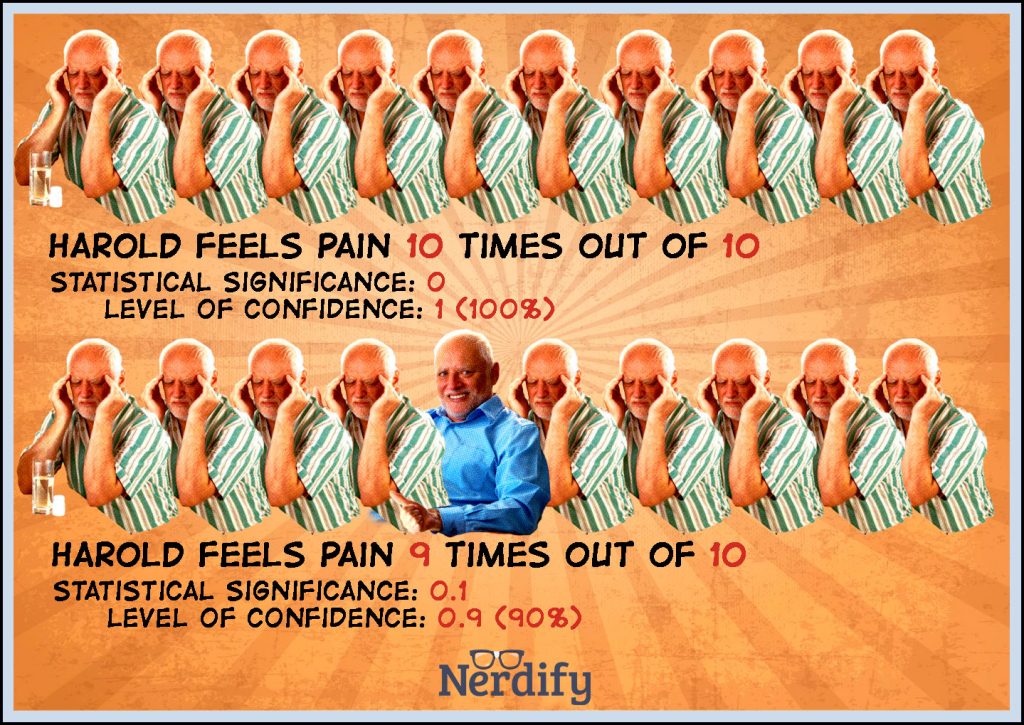
❓ Statistical significance — is the likelihood of that the relationship between two or more variables is accidental and the results of the observation are caused by something else than just chance.
For instance, if a patient gets anxiety every time he does online research about health issues, then statistically the probability of getting anxiety, aka level of confidence is 100%, or 1.
If a patient gets anxiety in 9 times out of 10, then we can confidently state that the probability here is 90%, or 0.9.
The most typical levels of significance are 0.05 and 0.01 — both are 100% safe to use in your paper. I chose 0.01 because the lower the value, the more significant results you’ll get — lower significance implies a lower risk of error.
Why do we need the level of significance? My Nerd had a good metaphor to explain it. Imagine that you have to climb up a ladder that has 100 steps. The more steps are missing, the higher the risk that you’ll fall. That’s why we set a very low level of significance — to make sure that calculations are correct!
3️⃣ State your Hypotheses
The hypothesis is a fancy word that confuses many students, but in reality, the hypothesis is just an assumption that you have. In chi-square, you’ll need 2 of them.
- Null hypothesis (H0)– usually states that the results of the observations could result purely from chance and the variables are independent — if one of them changes, another one stays the same and doesn’t react to the changes in the first one.
My H0 would say that getting anxiety isn’t connected with researching health issues online.
- Alternative hypothesis (H1) states that the sample observations result not from a random cause, but from a specific cause and the variables are dependent in some way.
That is, my H1 says that patients really do get anxiety and experience negative feelings after researching health issues online.

4️⃣ Fill in Observed Values
Here just enter all the observed values into the table:
❓ Observed value — what actually happened or how many times you’ve seen something occur. For instance, how many respondents out of 100 admitted to frequently research online about mental issues and get anxiety from it
Increased anxiety No change Total Frequently research 36 9 45 Rarely research 24 31 55 Total 60 40 100
5️⃣ Calculate Expected Value
Here we calculate values that would be observed in case if there would be no relationship between researching health issues and experiencing negative emotions.
❓ Expected value — it’s calculated by the formula below and show what would happen if the variables were absolutely independent — wouldn’t affect each other at all.
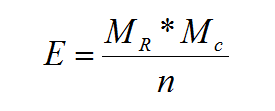
where
- E — expected value
- Mr — row total for the cell you’re calculating an expected value for
- Mc — column total for that cell
- n — sample size
Increased anxiety No change Total Frequently research 27 18 45 Rarely research 33 22 55 Total 60 40 100
- Expected value for “frequently research, increased anxiety” E=45*60/100=27
- Expected value for “only rarely research, increased anxiety” E=55*60/100=33
- Expected value for “frequently research, no negative emotions” E=45*40/100=18
- Expected value for“only rarely research, no negative emotions” E=55*40/100=22
6️⃣ Calculate Chi-Square Using the Formula
Once again, you can use online calculators, but this how it’s done in practice (aka the hard way):

Not ready yet to move further with chi-square test?
Find your Nerd to ease your pain. In anything. Unless it’s legal. 😎
🧐 Get Connected to a Personal Nerd!
7️⃣ Calculate Degrees of Freedom and Critical Value
Now that we got chi-square calculation done, let’s calculate the degrees of freedom
❓ Degrees of freedom (df) — the number of independent variables that went into the calculation.
Just think of those promotions “buy 2 — get 1 for free!” — you’re free to choose several things, but +1 product is always set by the promotion. Degrees of freedom, however, subtract 1 from both your rows and columns.

You need to use a chi-square distribution table and find your critical value at the intersection of the degrees of freedom (df=1) and the level of significance (α=0.01):
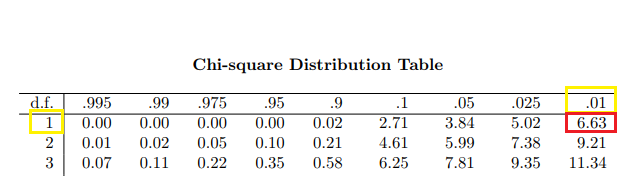
So, our critical value is 6.63. This value is smaller than our χ2 =13.63 Therefore, in our chi-square test example, researching about health issues online and getting anxiety or negative emotions are related.
We don’t know how much they are related, because chi-square doesn’t answer this question. But we definitely know that they are somehow related.👌
Chi-Square Calculators — the Easy Way
Even if you need to do all the difficult calculations by yourself, these calculators are awesome to verify your results. Or, if you’re lucky, online calculators are all you’ll need to use to calculate chi-square!
- Social Science Statistics Calculator — easy to use chi-square calculator that can calculate up to 5 rows and 5 columns. You can enter category names, fill in the data, and get the result in a flash.
- Kent University SPSS Guide for Chi-Square — if you have SPSS, you can consider your chi-square test pretty much already done. This guide will help you learn how to import chi-square tables and graphs into the SPSS and get the task solved. Many colleges and universities use SPSS as their default tool, and your professor may ask you to show your SPSS datasheet.
- Chi-Square Calculator — another extremely simple online chi-squared test calculator. All you need to do is enter the observed values and you’ll get degrees of freedom and chi-square ready.
How Can You Nail Chi-Square: My Pro Tips
If anyone told me I would be able to do it just a week before connecting with a Nerd, I’d never believed it. It was simple and logical explanations from my Nerd that helped me completely nail chi-square test and do all the calculations by myself.
Now, I understand each step of chi-square and interpret results correctly. For me, it was crucial that a professional, with a background in studying and applying statistics in practice, would explain everything to me in human language, not math language.
And now a few tips for you to cut corners if you’re dealing with chi-square:
- Keep in mind that chi-square isn’t rocket science — it is doable and actually very easy if you have a really simple and detailed guideline
- The number of rows and columns can vary and your table can be much larger than mine, however, the principle remains the same — you’ll just need to do more arithmetic
- When calculating the expected value, you’ll most likely get fractions, which can confuse you, especially if you’re calculating the number of people in each category. Don’t bother about it — these calculations are intended for further calculation of chi-square
That’s all I wanted to share in my feedback story today. Hopefully, it will help you nail chi-square and get the grade you deserve! Chi-square isn’t as difficult as it may seem at first, so go ahead and break a lance!
Of course, you can make your own success story too!
Nerdify is an AI-powered platform to quickly connect with the experience of 1000s of Personal Nerds